Practical UK Damp & Mould Guide
Signs Professional Mould Removal Is Needed
Learn when a mould problem may be too extensive, persistent or complex for routine household cleaning—and what a competent inspection and remediation process should involve.
This article provides general information. It is not a medical diagnosis, building survey or site-specific clearance decision.
Professional mould removal is worth considering when growth is widespread, keeps returning, has entered porous materials or may be concealed within the building. The decisive issue is not simply the colour of the mould. It is the source and duration of the moisture, the extent of affected materials, the people who may be exposed and whether the area can be assessed and cleaned without spreading contamination.
A small patch caused by short-term surface condensation may sometimes be manageable after the moisture problem is corrected. A leak, flood, persistent humidity problem or concealed defect can require a more detailed investigation. Painting over growth or repeatedly wiping the same patch does not resolve the underlying cause.
Damp and mould can affect the airways and lungs and may also irritate the eyes and skin. Children, older people and people with allergies, asthma, chronic respiratory conditions or weakened immunity may be more susceptible. Seek medical advice about symptoms; use urgent or emergency NHS services when clinically appropriate.
Signs That Professional Help May Be Appropriate
There is no single visual test or universal household cut-off that decides every case. A competent person should consider the whole situation. Professional assessment or removal is particularly sensible where one or more of the following applies:
Large or spreading growth
Mould extends across substantial areas, affects several rooms or continues into wall, ceiling or floor finishes.
Repeated regrowth
The same area returns after cleaning, suggesting that moisture remains uncontrolled or growth is deeper than the surface.
Concealed contamination
A persistent musty smell, staining or building history suggests mould behind wallpaper, panelling, cupboards or floor coverings.
Porous materials
Plasterboard, insulation, soft furnishings, carpets or other absorbent materials have been wet or visibly affected.
Flood or sewage involvement
Contaminated water, prolonged saturation or difficult drying introduces hazards beyond ordinary surface mould.
Higher-risk occupants
Someone living or working in the property is especially susceptible or is reporting symptoms associated with the environment.
Professional help may also be needed where safe access is difficult, structural materials are damaged, electrical hazards are present or the likely source requires a roofer, plumber, drainage contractor, ventilation specialist or building surveyor.
Area can help describe the scale, but it does not decide the method by itself. A smaller concealed patch caused by an active leak may require more investigation than a larger, superficial area caused by an isolated condensation event.
Why Colour Does Not Identify the Risk
Terms such as “black mould” describe appearance, not a laboratory identification or a reliable measure of toxicity. Different moulds can appear black, green, brown, white or orange, and the colour can change with the surface, moisture and stage of growth. It is not possible to determine species, health significance or the correct removal method from colour alone.
The practical response is usually the same: limit avoidable exposure, find and correct the moisture source, assess the extent and remove affected material using a method that does not spread contamination. Laboratory identification is not automatically required simply because growth is dark.
Hidden Mould and Concealed Moisture
Mould may grow out of sight where moist air or water reaches cooler or absorbent materials. Warning signs can include a musty odour, recurrent staining, bubbling paint, peeling wallpaper, warped boards, crumbling plaster, damp skirting or deterioration around windows and external walls.
Common concealed locations include behind fitted furniture, wall linings and wallpaper; under carpets and laminate; within service voids; around baths and showers; beneath sinks; inside roof spaces; and below floors affected by a leak or flood.
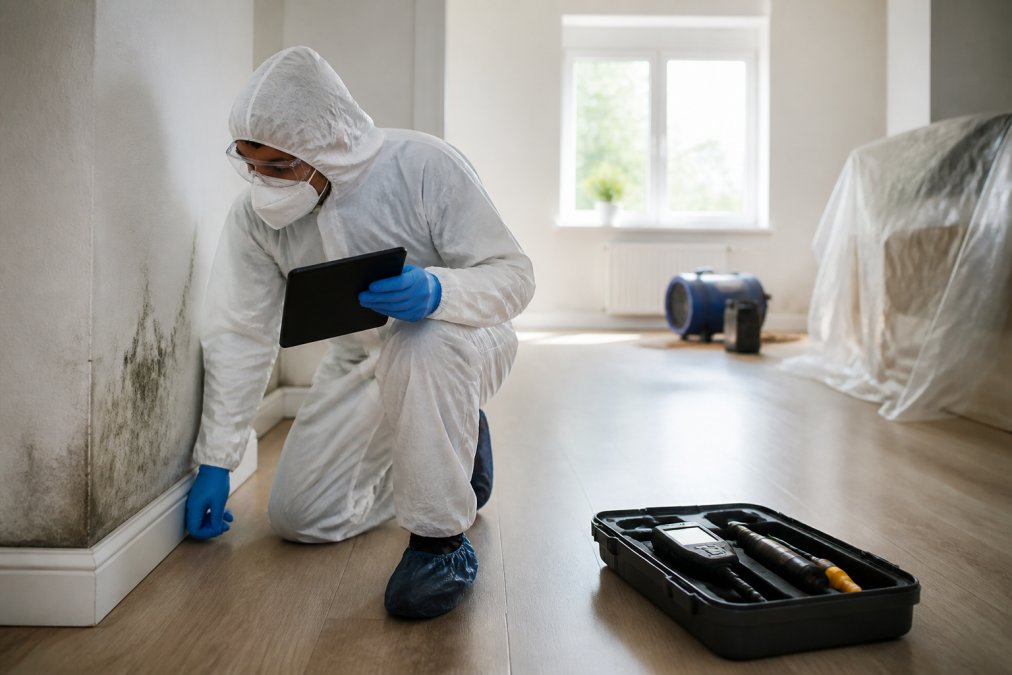
Pulling away wallpaper, lifting flooring or cutting plasterboard can release dust and spores and expose a larger wet area. If growth is extensive, the material may be contaminated on both sides or other hazards may be present. Arrange a controlled inspection instead.
Health Concerns and Vulnerable Occupants
Government and NHS guidance recognises that damp and mould can contribute to respiratory symptoms and other health effects. Sensitivity varies, so the appearance of the room does not reliably predict how a particular person will respond.
Take reports of symptoms seriously. Reduce avoidable time in the affected space where practicable, especially for susceptible occupants, and obtain health advice from an appropriate clinician. A cleaning contractor can assess a property and its materials but cannot diagnose the cause of symptoms.
Reliable public guidance is available from the UK Government’s damp and mould guidance and the NHS advice on damp and mould.
Finding and Correcting the Moisture Source
Mould requires moisture. Unless the moisture source is identified and controlled, cleaning may provide only a temporary cosmetic improvement. More than one cause can be present at the same time.
| Possible source | Typical clues | Useful next step |
|---|---|---|
| Condensation | Growth on cold corners, window reveals, external walls or behind tightly placed furniture | Review heating, ventilation, moisture production, air movement and insulation or thermal bridging |
| Plumbing leak | Localised staining, swollen materials, persistent dampness or a changing water-meter reading | Stop and repair the leak, then assess the wet materials and drying requirements |
| Rain penetration | Dampness associated with weather, roof areas, defective gutters, masonry or openings | Inspect and repair the building envelope before redecorating |
| Ground or below-floor moisture | Low-level dampness, damaged finishes, salts, odour or wet subfloor conditions | Obtain a competent building assessment rather than assuming a single diagnosis |
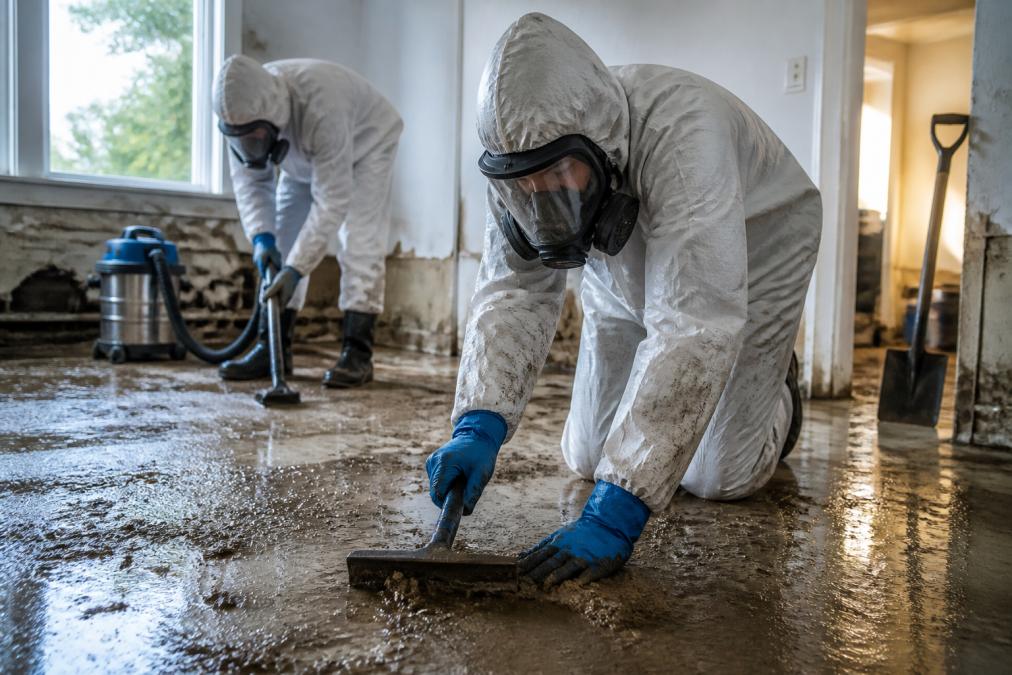
| Flooding | Water marks, wet cavities, saturated insulation or widespread floor-level damage | Classify the water source, remove unsafe materials and use a documented drying plan |
| Everyday moisture | Problems linked to cooking, bathing, clothes drying or overcrowding | Improve extraction and ventilation while checking that the building can be heated and ventilated effectively |
For more detail on water-related incidents, see when to call professional cleaners after a flood and the guide to flood-damage cleaning in the UK.
Need Advice About Persistent or Widespread Mould?
TrustedCare can discuss the affected rooms, likely moisture source and whether a site visit or specialist remediation may be appropriate.
What a Professional Inspection May Include
A useful inspection starts with the history of the building and the moisture event. The inspector should ask when the problem began, where it appears, what repairs or cleaning have already been attempted and whether the pattern changes with weather, occupancy or heating.
The scope may then include visual inspection, non-destructive moisture assessment and targeted checks of accessible voids. The tools are aids to professional judgement, not proof on their own:
- Moisture meters can help compare areas and track drying, but readings depend on the material, instrument and method. One fixed percentage cannot declare every wall, floor or timber component dry.
- Thermal imaging shows surface temperature patterns. It may help locate areas for further investigation, but it does not directly detect mould or confirm the source of moisture.
- Borescopes can help inspect a targeted cavity through a small opening, provided the opening can be made and managed safely.
- Environmental monitoring or sampling may help in selected complex cases, but results require competent interpretation and are not a substitute for finding the moisture source.
Visible mould and damp are often enough to justify action without routine species testing. There is no single air-sample number that, in isolation, proves every occupied property is safe or unsafe.
DIY Cleaning or Professional Remediation?
A small, isolated area on a non-porous or readily cleanable surface may sometimes be dealt with by the occupier after the cause of moisture has been corrected. Follow suitable product instructions, ventilate appropriately, avoid mixing chemicals and do not dry-brush or sand visible growth.
Stop and obtain professional advice if the work would disturb a large area, open cavities, remove heavily affected porous materials, involve contaminated floodwater or require respiratory protective equipment that has not been properly selected and fitted. The same applies where the source is uncertain, structural damage is suspected or regrowth continues.
If cleaning the visible surface cannot also deal with the moisture source and the full affected material, the job is no longer just routine household cleaning.
What Professional Mould Remediation Should Involve
The exact method should be site-specific. A professional process will usually separate assessment, source control, removal, cleaning, drying and verification rather than treating a single chemical application as the complete solution.
- Confirm the brief and immediate precautions. Identify affected rooms, occupants, access restrictions and other hazards.
- Investigate the moisture source and extent. Record visible growth, likely hidden spread, wet materials and areas that could not be inspected.
- Plan containment and access. Select a method that limits transfer of dust, debris and affected materials through clean spaces.
- Correct or isolate the source. Coordinate leak repair, ventilation, building work or flood response so moisture does not continue.
- Remove unsalvageable porous materials. Bag or contain waste in accordance with the site plan and applicable requirements.
- Clean retained surfaces and contents. Use methods and products suitable for the material and the contamination.
- Dry the structure. Monitor conditions using material-appropriate readings and comparison points, not a universal target copied from another property.
- Inspect and document the outcome. Record completed work, residual limitations, reinstatement requirements and follow-up actions.
Drying, Verification and Aftercare
Completion should be judged against the agreed scope. Depending on the project, this may include confirming that visible dust, debris and growth have been removed; checking that retained materials are acceptably dry for their type and location; documenting areas that remained inaccessible; and confirming that the moisture source has been repaired or placed under a separate action plan.
Sampling is not automatically needed at the end of every project. Where it is specified, the purpose, method, comparison criteria and person interpreting the results should be agreed in advance. A contractor should not make broad medical assurances or promise that a property is “mould-free”, because mould spores occur naturally indoors and outdoors.
Monitor the repaired area after occupancy and through relevant weather or seasonal conditions. Any renewed odour, staining, condensation or visible growth should trigger a review of the source and repairs rather than another cosmetic wipe-down.
Landlords, Tenants and Insurance
Tenants should report damp and mould promptly in writing, include photographs obtained safely and retain a record of dates and responses. Landlords should investigate the underlying cause and act on the building and health risks rather than treating mould solely as a housekeeping issue. The precise legal duties and routes for escalation vary across England, Scotland and Wales, property type and tenancy.
For an insured property, notify the insurer as soon as reasonably possible. Cover depends on the policy and the cause of the damage; gradual deterioration and condensation may be treated differently from a sudden escape of water. Keep photographs, repair reports, moisture records, invoices and a list of damaged contents. Do not delay urgent steps needed to prevent further damage, but check the policy and obtain authorisation where required.
Questions to Ask Before Accepting a Quotation
- What is believed to be causing the moisture, and is source repair included?
- Which rooms, surfaces, contents and concealed areas are within the scope?
- What will be retained, cleaned, removed or replaced?
- How will the work area and waste route be contained?
- What drying measurements will be taken, and how will they be interpreted?
- Are reinstatement, decoration and specialist building repairs included or excluded?
- What completion records and aftercare advice will be provided?
- What could change the price once materials are opened or hidden damage is found?
Ask for a written, property-specific scope. A quotation that promises only to “spray and paint” without addressing moisture, affected porous materials or concealed spread may not resolve the problem. For budgeting context, see the guide to mould-removal costs in the UK.
Frequently Asked Questions
Can I identify dangerous mould by its colour?
No. Colour alone cannot reliably identify a species, its health significance or the correct remediation method. Focus on moisture, extent, affected materials and exposure.
Is there a fixed size above which a professional is always required?
No universal area threshold decides every case. Extent matters, but so do the cause, duration, material, hidden spread, access and susceptibility of occupants.
Does bleach permanently remove mould?
No product can provide a permanent result while the moisture source remains. Some products may damage materials or create exposure risks. Never mix cleaning chemicals, and follow the label and relevant safety information.
Does thermal imaging detect mould?
No. A thermal camera displays surface-temperature differences. Those patterns can guide further investigation but do not directly show mould or prove why an area is damp.
Do I need air testing before mould removal?
Not routinely. Visible damp or growth is often enough to justify corrective action. Sampling may help answer a specific question in a complex case, provided a competent person designs and interprets it.
Can mould return after professional cleaning?
Yes, if moisture returns or affected material was missed. The best protection is effective source repair, adequate drying, suitable ventilation and follow-up observation.
Should I stay in the property during removal?
That depends on the scale, work method, layout and occupants. The contractor’s risk assessment should define isolation and access. Seek medical advice where individual health circumstances affect the decision.
Will insurance pay for mould remediation?
It depends on the policy and cause. Contact the insurer promptly, document the damage and ask what emergency work, surveys and quotations it requires.
Discuss a Damp or Mould Problem With TrustedCare
Share the affected area, how long the problem has been present and any known leak, flood or ventilation issue. TrustedCare can advise on the next practical step across England, Scotland and Wales.
For urgent medical symptoms, contact the appropriate NHS service. For immediate danger, use the relevant emergency service.
