Table of Contents
- What Makes Hoarding Properties Risky to Clean
- Hoarding Cleanup Health and Safety Risks
- Waste Disposal Regulations for Hoarding Properties
- Planning the Cleanup of Hoarding Properties: A Step-by-Step Approach
- Common Mistakes and Legal Considerations for DIY Cleaners
- When to Call Professional Hoarding Cleaning Services in the UK
- Supporting Someone Through the Clearance Process
- Frequently Asked Questions
What Makes Hoarding Properties Risky to Clean
Cleaning a hoarding property safely means treating the home as a hazard site first and a tidying job second. The risks come from what is hidden, not what is visible.
Blocked exits, unstable stacks and unseen sharps are common. Pest infestations, mould and spoiled food add to the danger. Dust and ammonia build up in the air.
This guide explains how to safely clean hoarding properties in stages. It covers risk assessment, protective equipment, waste rules and when to bring in specialists.
Hoarding Cleanup Health and Safety Risks
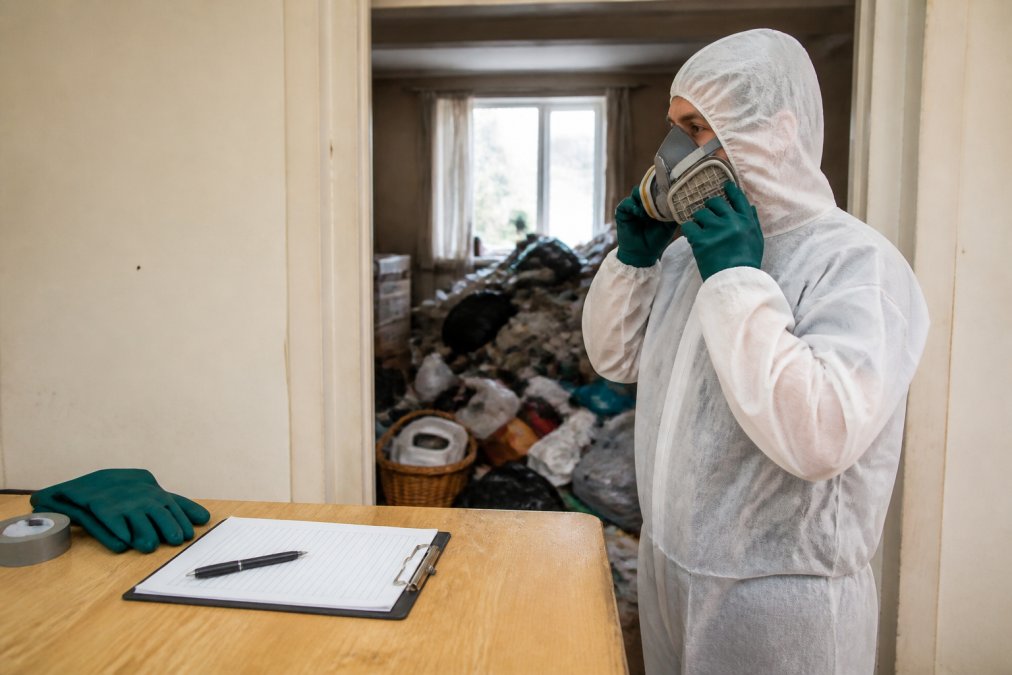
Hoarding cleanup health and safety risks fall into four groups: biological, structural, chemical and psychological. Each needs a different control.
- Biological: mould spores, pest droppings, spoiled food, bodily fluids
- Structural: collapsing stacks, weak floors, blocked fire exits
- Chemical: cleaning products mixed together, gas leaks, exposed wiring
- Psychological: severe distress during sorting and disposal
The Health and Safety Executive guidance on risk assessment sets out the five-step approach used on most sites.
A common mistake is starting to clear before assessing. That is how injuries and cross-contamination happen.
Personal Protective Equipment and Risk Assessment
Personal protective equipment (PPE) is the minimum barrier between the cleaner and the contamination. It is not optional.
Basic PPE for hoarding work includes:
- Disposable coveralls with a hood
- FFP3 respirator, fit-tested
- Nitrile gloves, doubled for wet work
- Safety boots with puncture-resistant soles
- Eye protection and a hard hat where stacks are unstable
Never enter a hoarding property alone where floors may be weak or stacks unstable. A fall or collapse with no one nearby turns a cleanup into an emergency.
Waste Disposal Regulations for Hoarding Properties
Waste disposal regulations for hoarding properties depend on what the waste is. Household clutter and hazardous waste follow different routes.
- General waste: bulky waste collection or a licensed skip
- Hazardous waste: sharps, chemicals, asbestos, clinical waste
- Electrical waste: fridges, TVs, batteries
- Contaminated soft furnishings: often clinical or offensive waste
Planning the Cleanup of Hoarding Properties: A Step-by-Step Approach
Planning works best in four phases: assess, clear, clean, then maintain. Rushing any phase creates new risks, and the equipment and pace should change depending on how severe the situation is.
| Phase | Main task | Typical duration | Who leads |
|---|---|---|---|
| Assess | Risk assessment, plan, consent | 1-2 hours | Competent adult or specialist |
| Clear and sort | Remove, categorise, dispose | Days to weeks | Team with PPE |
| Clean and decontaminate | Surfaces, air, pests, residues | 1-3 days | Cleaning team |
| Maintain | Follow-up, relapse prevention | Ongoing | Occupier with support |
Match the toolkit to the level of hoarding
Not every property needs the same approach. A useful distinction is between clutter, congested living and hazardous hoarding.
- Clutter: walkways mostly clear, no significant contamination. Basic gloves, bags and a sorting system are usually enough.
- Congested living: one or more rooms unusable, some pest or mould activity. Add FFP3 respirators, coveralls, sharps handling and a licensed waste route.
- Hazardous hoarding: blocked exits, structural concerns, sewage, sharps, chemicals or decomposition. This is specialist territory. Do not attempt a DIY clearance.
Step 1: Assess the property and agree a plan
Start with a walk-through, not a clear-out. Note hazards, exits, structural concerns and any signs of contamination. Photograph the condition before anything moves, both for insurance and for the record.
Step 2: Clear, sort and categorise safely
Work room by room, and always from the exit inward so you never trap yourself. Use a simple four-way sorting system:
- Keep: documents, medication, valuables, sentimental items
- Donate: clean clothing and usable goods
- Dispose: spoiled food, damaged items, hazardous waste
- Review later: anything the person is unsure about
Step 3: Clean and decontaminate
Cleaning comes after clearing, never before. Surfaces, floors and air need separate attention. Decontamination targets mould, pests and residues; deep cleaning covers kitchens, bathrooms and high-touch areas. Where sewage, bodily fluids or decomposition contamination are present, this is a specialist task and not a DIY one.
Step 4: Plan ongoing maintenance
A post-cleanup maintenance plan is the step most guides skip. Without it, re-accumulation is common.
- Book a follow-up visit four to six weeks after clearance
- Agree a simple rule for what comes into the home
- Involve a GP or mental health service where hoarding behaviour is ongoing
- Keep a named contact for future concerns
Early signs of re-accumulation are far easier to manage than a full second clearance. A short check-in is more effective than a long clean-out.
Common Mistakes and Legal Considerations for DIY Cleaners
DIY clearance can be reasonable for mild clutter. It becomes unsafe once contamination, pests, sharps or structural damage are present, and it becomes legally complicated the moment you are handling someone else’s property or waste.
Mistakes that cause the most harm
- Starting to clear before a written risk assessment exists
- Mixing hazardous and general waste in one bag or skip
- Skipping PPE because a room “looks clean”
- Discarding documents, medication or valuables by accident
- Working alone in a property with weak floors or unstable stacks
- Assuming household insurance covers the clearance without checking the policy
Who has the right to enter and remove items
This is where most guides stop, and it is where DIY cleaners get into difficulty. The answer depends on your relationship to the property and the person.
- Owner-occupier: you can clear your own home, but you still owe a duty of care for how waste is handled.
- Landlord: your rights come from the tenancy agreement and from housing law, not from convenience. A tenant’s home is their legal residence even when it is unsafe, and self-help eviction or unauthorised entry can expose you to claims. The GOV.UK guidance on rented housing standards and your local authority’s environmental health team are the sensible starting points.
- Family member or friend: you generally need the occupier’s consent, or a legal authority such as lasting power of attorney, deputyship or probate where the person has died. Removing items without that authority can be treated as theft or trespass, even with good intentions.
- Executor after a death: you can act within the estate, but you must keep records of what was removed, what was disposed of and what was sold. See our guide to after-death and unattended-death cleaning for how this interacts with contamination risks.
Waste duty of care in practice
Under the waste duty of care, anyone producing waste must take reasonable steps to confirm it is stored, transported and disposed of safely, and only handed to an authorised carrier. In practice that means:
- Checking the carrier’s registration before waste leaves the property
- Keeping a waste transfer note for each handover
- Segregating hazardous, electrical, clinical and general waste streams
- Never using a “man with a van” who cannot show where waste is going
Insurance and liability
If you are unsure who has the legal right to enter, remove or dispose of items, pause and take advice. Undoing an unlawful clearance is far harder than planning a lawful one.
For a broader view of when DIY stops being sensible, see our section on professional services below.
When to Call Professional Hoarding Cleaning Services in the UK
Professional hoarding cleaning services in the UK are worth considering when any of the following apply:
- Structural damage or weak floors
- Significant mould, pests or sewage
- Sharps, chemicals or suspected asbestos
- Severe emotional distress during clearance
- A deadline such as a sale, court order or rehousing
The decision is not about pride. It is about whether the risks can be managed safely with the people and equipment available.
Supporting Someone Through the Clearance Process
Hoarding behaviour is often linked to emotional distress. The clearance itself can be a trigger.
- Explain each step before it happens
- Let the person keep a small number of chosen items
- Avoid surprise disposals
- Offer to involve a GP or mental health service where appropriate
Frequently Asked Questions
What are the main health and safety risks when cleaning hoarding properties?
The main risks include trips and falls from blocked routes, structural damage from excessive weight, rodent and insect infestations, mould growth from damp, and exposure to sharps or biological contamination. Dust and ammonia from animal waste can affect air quality and breathing. A written risk assessment before starting helps identify these hazards. If you find needles, human waste, or signs of severe structural stress, stop and seek professional assessment rather than continuing alone.
How does the Environment Agency regulate waste disposal from hoarding properties?
In England, waste from a hoarding clearance is classed as household or commercial waste depending on the property. You must use a licensed waste carrier and obtain a waste transfer note. The Environment Agency enforces duty of care rules, and fly-tipping or burning waste can lead to fines. Some items, such as chemicals, paint or asbestos-containing materials, require specialist disposal. Always check with your local authority or the Environment Agency before disposing of anything you are unsure about.
When should I call professional hoarding cleaning services in the UK?
Call a professional if the property has structural damage, severe pest infestation, sharps, human or animal waste, or hoarding that blocks fire exits. You should also seek help if the person has hoarding disorder and is distressed by the clearance. Professional teams can carry out risk assessments, use specialist PPE and arrange legal waste disposal. If you are a landlord or housing association manager, professional services can help you meet health and safety duties under the Housing Act 2004 and the Regulatory Reform (Fire Safety) Order 2005.
What should I avoid doing when clearing a hoarder’s home?
Do not throw items away without the person’s agreement, as this can cause emotional distress and damage trust. Never enter a property with obvious structural damage or strong chemical smells. Avoid dry sweeping, which spreads dust and pathogens; use damp methods or a vacuum with a HEPA filter instead. Do not attempt to clean bodily fluids, sewage or sharps yourself. Do not ignore fire risks from blocked exits or overloaded sockets, and do not skip a risk assessment before starting work.
