Specialist cleaning begins where ordinary hygiene procedures are no longer enough. Blood or bodily fluids, decomposition, sewage, sharps, animal waste, chemical residues and contaminated floodwater can expose workers and occupants through contact, splashes, inhalation, ingestion or puncture injury. The correct response depends on what is present, how far it has travelled, the materials affected and the people who could be exposed.
This guide is for property owners, landlords, housing teams, facilities managers and buyers assessing a contractor’s proposed safety arrangements. It explains the principles behind a competent system without pretending that one method fits every scene. Start with UKBB’s biohazard risk-assessment guide if the contamination has not yet been scoped.
What specialist cleaning safety protocols include
A protocol converts an assessment into an organised way of working. It should state who controls the site, which areas are restricted, how technicians enter and leave, the controls used for each hazard, how equipment is cleaned, where waste goes and how the area will be released.
The written documents matter, but paperwork alone does not make a job safe. The controls must be available, understood and followed. If the actual conditions differ from the plan—perhaps contamination is found below flooring or an unknown chemical container is discovered—the team should stop, reassess and record the change.
When routine cleaning guidance stops being enough
Ordinary cleaning guidance generally assumes familiar products, limited soiling and no unusual exposure. Specialist assessment is appropriate where contamination is extensive, can enter the body, has penetrated porous materials, contains sharps, may be airborne, involves an unknown substance or requires controlled waste disposal.
How a site-specific risk assessment is built
A useful assessment describes the actual property and task. It should be completed by someone competent to recognise the hazards and decide proportionate controls. Remote information can help plan the visit, but photographs and a telephone description may not reveal contamination beneath finishes, electrical hazards, structural damage, pests or needles.
| Assessment area | Questions to answer | Effect on the plan |
|---|---|---|
| Source and extent | What is known, what remains uncertain and which materials or voids may be affected? | Defines the work zone, survey limits and whether destructive inspection is justified. |
| Exposure routes | Could material contact skin or eyes, be inhaled or swallowed, or cause a puncture? | Determines controls, work methods, hygiene arrangements and PPE. |
| People at risk | Workers, residents, visitors, neighbours, pets or other contractors? | Determines access restrictions, communication and safeguarding measures. |
| Property hazards | Electricity, unstable materials, confined access, asbestos risk, poor ventilation or fire precautions? | May require another competent trade, survey or isolation before cleaning. |
| Products and equipment | Which chemical, concentration, contact time and application method are suitable? | Feeds the COSHH assessment and prevents unsafe mixing or ineffective use. |
| Waste | What will be removed and how should each stream be classified, packaged and transferred? | Sets containers, storage, carrier, paperwork and destination requirements. |
| Completion | What inspection, readings or tests are proportionate, and what are their limitations? | Creates an objective release and handover standard. |
The assessment should also cover foreseeable emergencies: a sharps injury, splash to the eyes, respirator problem, chemical spill, loss of ventilation or discovery of an unidentified material. Workers need to know who to contact, where first-aid and washing facilities are and what information must accompany medical advice.
The hierarchy of controls in specialist cleaning
COSHH requires exposure to hazardous substances to be prevented where reasonably practicable or otherwise adequately controlled. The hierarchy matters because PPE protects only the person wearing it and can fail through poor selection, damage, incorrect use or contamination during removal.
- Eliminate or avoid the hazard where possible: do not create aerosols unnecessarily; do not dry-sweep contaminated dust; remove people who do not need to be present.
- Change the process: use a lower-splash method, suitable tools, closed containers or direct bagging rather than carrying loose material.
- Use engineering controls where justified: barriers, local extraction or controlled ventilation may be appropriate after the airborne risk and discharge route have been assessed.
- Use administrative controls: restricted access, signs, training, supervision, a defined work sequence and controlled breaks.
- Select PPE for residual risk: gloves, clothing, eye protection and RPE should match the remaining exposure routes.
When containment and airflow controls are justified
Physical containment may range from a closed door and controlled access to a more formal barrier and transition area. Negative pressure or air filtration is not an automatic requirement for every biohazard clean. It may be appropriate where the assessment identifies an airborne contaminant or a process that could generate hazardous aerosols or dust, and only when the equipment, filter, airflow and safe exhaust route are suitable.
Poorly planned extraction can move contamination, depressurise combustion appliances or discharge polluted air near neighbours or fresh-air intakes. It should therefore be treated as an engineered control, not simply another machine placed in the room.
PPE and respiratory protective equipment
PPE is selected by task and exposure route. A photograph of technicians wearing white coveralls does not prove that the equipment is suitable. The specification should consider protection level, compatibility with chemicals, durability, dexterity, heat stress, work duration and how the equipment will be removed or cleaned.
| Protection | What the assessment should consider | Common limitation |
|---|---|---|
| Gloves | Biological or chemical hazard, puncture risk, breakthrough time, cuff coverage and need for task dexterity | One glove material is not resistant to every chemical; double-gloving does not replace correct selection. |
| Protective clothing | Liquid splash, particles, seams, closure, footwear interface and disposal or decontamination | Damage, open zips and contaminated removal can defeat protection. |
| Eye or face protection | Splash direction, impact risk, compatibility with RPE and visibility | Ordinary spectacles do not provide the same coverage as suitable protective eyewear. |
| Foot protection | Slip, puncture, chemical contact, water ingress and whether covers create additional trip risk | Disposable overshoes can tear and may be unsuitable for wet or uneven floors. |
| RPE | Nature and concentration of contaminant, particles or vapour, required protection factor, work rate, wear time and face compatibility | The wrong filter or a poor face seal can provide inadequate protection. |
Fit testing applies to tight-fitting RPE
Where tight-fitting respiratory protective equipment is selected, it must fit the individual wearer. HSE guidance explains that tight-fitting facepieces need fit testing because leakage around the seal prevents adequate protection. The wearer should also complete the required pre-use seal check each time, be clean-shaven in the seal area and use the same make, model, type and size that passed the fit test.
Loose-fitting powered hoods use a different principle and do not rely on a face seal, although they still require correct selection, maintenance and use. A claim that “everyone needs an FFP3 mask” is not a risk assessment: the equipment must be suitable for the contaminant and task.
Putting on and removing PPE
There is no safe universal doffing order that overrides the manufacturer’s instructions and the site plan. The sequence depends on the combination of equipment and which surfaces are contaminated. The core principles are to avoid touching the face or clean clothing, remove the most contaminated items in the defined transition area, contain disposables immediately, place reusable equipment in a labelled receptacle and perform hand hygiene at the specified stages.
Training should be practical. Workers need to demonstrate the sequence, not only sign a sheet. A buddy check can identify open fastenings, damaged gloves or contaminated contact that the wearer cannot see.
Work zones and cross-contamination control
Cross-contamination occurs when material moves from the affected area to a clean surface on hands, tools, footwear, wheels, hoses, waste bags or air currents. A simple zoning plan helps keep movement controlled:
- Contaminated work area: access is restricted and task PPE is worn.
- Transition area: items are wiped, contained or transferred; PPE is removed according to the plan.
- Clean area: clean equipment, paperwork, phones, drinks and personal clothing are kept away from contamination.
The familiar terms “hot”, “warm” and “cold” can help communication, but labels alone do nothing. The protocol must control the doorway, floor protection, direction of travel, handling of phones and keys, equipment hoses, waste containers and technician breaks.
Cleaning tools, machines and vehicles
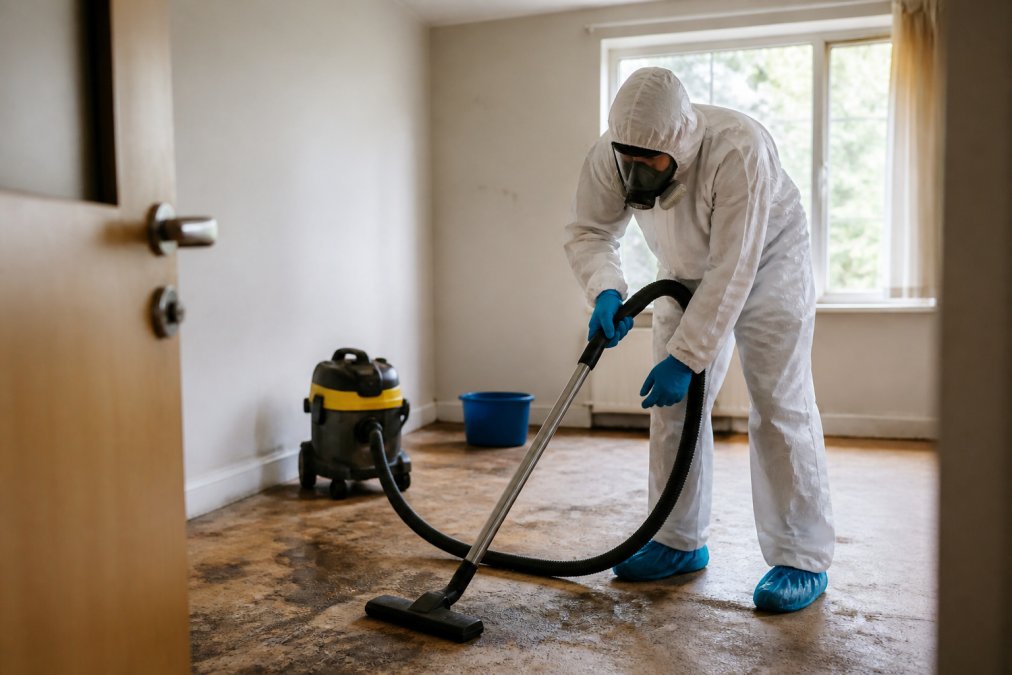
Reusable tools should have a defined decontamination method compatible with their materials and the contaminant. Electrical equipment must not be saturated. Filters, tanks, hoses and inaccessible internal surfaces require particular attention. If equipment cannot be made safe, it should not return to service.
The vehicle is part of the chain. Clean and contaminated items need separation, waste must be secured and any leakage dealt with under the incident plan. A van containing loose bags beside clean PPE is evidence that the site boundary has failed.
How protocols change for flood and sewage incidents
Floodwater can contain sewage, soil, fuels, chemicals, animal waste and other pollutants, but not every flood has the same contamination. The source, route, duration, materials contacted and activities planned should determine the precautions. Unknown floodwater should be treated cautiously until there is enough information to assess it.
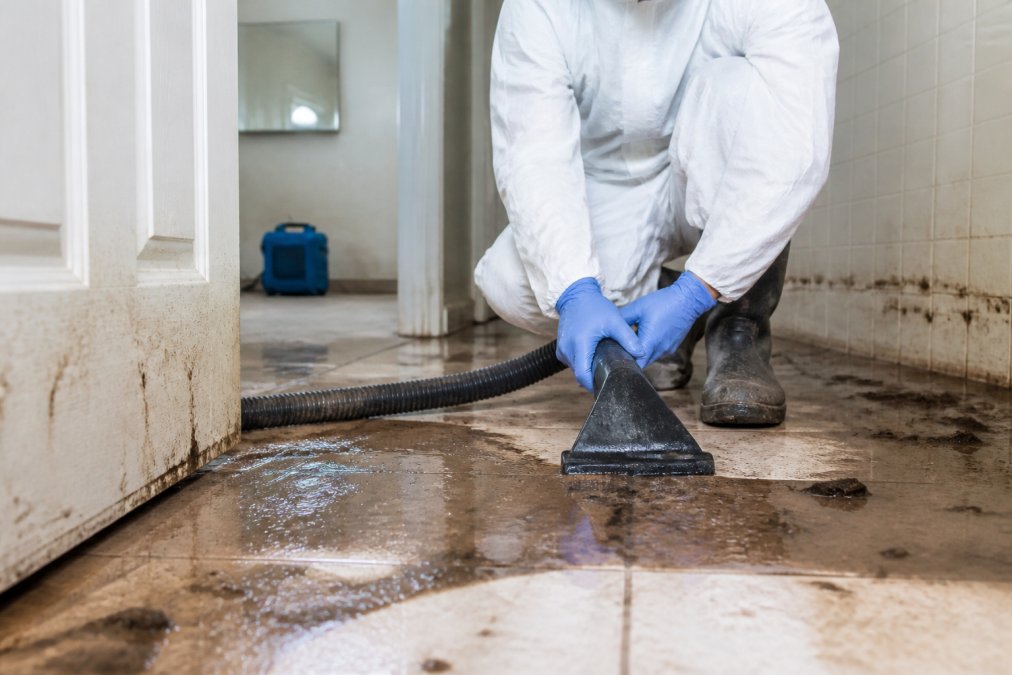
Operational “clean, grey and black water” categories may be used within parts of the restoration industry, but they are not a substitute for a UK workplace risk assessment or waste classification. Water can deteriorate or pick up contamination as it moves through a building.
Extraction, cleaning, decontamination and drying are different
- Water extraction removes standing water but does not prove that surfaces are clean.
- Physical cleaning removes soil and organic matter that can reduce disinfectant performance.
- Decontamination uses a suitable method and product for the identified hazard and material.
- Strip-out removes materials that cannot be effectively cleaned or dried.
- Structural drying removes excess moisture from retained building fabric and requires monitoring.
- Reinstatement restores finishes and is not proof that contamination or moisture was properly addressed.
Electrical and structural risks can be more urgent than infection risk. The team should not energise wet circuits or enter unstable areas without the appropriate assessment. Public-health advice also highlights hidden sharp objects and the need for hand hygiene during flood clean-up.
For the wider process, read UKBB’s guide to specialist cleaning after sewage incidents and when to call professional cleaners after a flood.
Need help with an active contamination incident?
UKBB provides general information. For availability, assessment or a specialist-cleaning quotation, contact TrustedCare directly.
Waste classification, sharps and secure transfer
“Biohazard waste” is not a complete legal classification. Waste should be described and coded according to what it actually contains and its hazardous properties. Items that look similar may follow different routes: an unused disposable coverall is not the same as one contaminated with infectious material or a hazardous chemical.
The waste plan should identify containers, segregation, labels, temporary storage, collection, carrier registration, destination and paperwork. Non-hazardous controlled waste generally uses a waste transfer note or equivalent required record. Hazardous waste movements generally require a consignment note. Rules and terminology differ across England, Wales, Scotland and Northern Ireland, so national regulator guidance must be checked.
Sharps need a separate approach
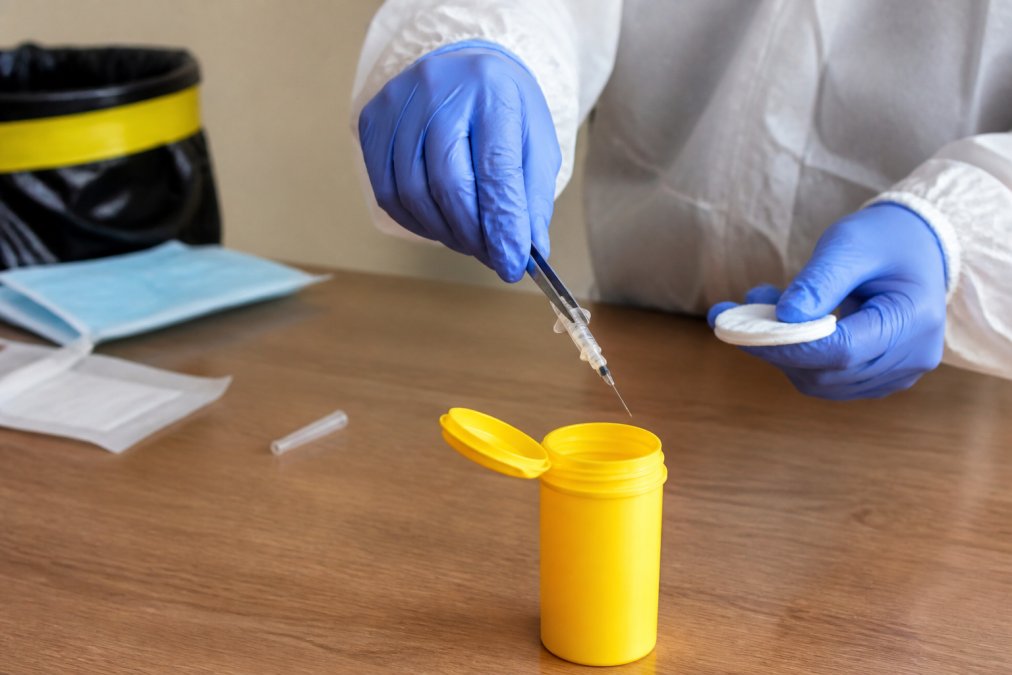
Needles and broken glass create a puncture route that ordinary gloves may not control. Do not pick up a loose needle by hand, recap it or force it into an overfilled container. The assessment should specify suitable tools, an approved sharps container positioned close to the item, adequate lighting and the response to an injury.
Verification, handover and evidence
Verification asks whether the defined objective was achieved. Documentation records what was planned and done. Neither replaces the other. A completed checklist cannot prove that a missed void is clean, while a test result without location, method or context may be impossible to interpret later.
The verification method should be selected before work starts and matched to the incident:
- Visual inspection is essential for scope completion and visible residue, but contamination can exist without being visible.
- Moisture readings support drying decisions when recorded at defined reference and target points using suitable instruments.
- ATP testing can indicate biological residue on a sampled surface but does not identify a particular pathogen and is not a universal clearance test.
- Microbiological sampling may answer a specific question when a competent person defines the method, locations, laboratory and interpretation.
- Odour assessment can support investigation of residual sources but is not proof of microbiological safety.
What a useful handover file contains
- Site-specific risk assessment and scope
- COSHH assessments and product information
- Method statement and significant changes
- Competence, training and relevant fit-test records
- Before, during and after photographs where appropriate
- Products, concentrations and contact times used
- Materials removed, retained and still requiring work
- Waste transfer or consignment records
- Moisture readings or other relevant test results
- A clear completion statement and exclusions
A property may be clean but not dry, dry but not decontaminated, or decontaminated but still awaiting electrical checks and reinstatement. The completion statement should say exactly what has been achieved rather than using a broad phrase such as “fully safe” without qualification.
How to assess a specialist-cleaning contractor
There is no single government-issued licence that proves competence for every specialist-cleaning incident. Certificates can support a decision, but they do not replace a relevant assessment, safe work plan, insurance and lawful waste arrangements.
Ask the provider:
- who will assess the site and what relevant experience they have;
- which hazards and exposure routes their method addresses;
- why the selected PPE and RPE are suitable;
- how tight-fitting RPE users are fit tested and supervised;
- how clean and contaminated items, tools and vehicles are separated;
- how products are selected, diluted and given the required contact time;
- how each waste stream is classified and documented;
- what employer’s liability and public liability insurance applies;
- how the work will be verified and handed over; and
- what is excluded from the quotation.
Vague statements such as “we always fog the room”, “we use full PPE” or “the machine makes negative pressure” should lead to more questions. A credible provider can explain what problem a control solves and what limitations remain. UKBB’s seven-step contractor-vetting guide provides a wider buyer checklist.
Frequently asked questions
What are specialist cleaning safety protocols?
They are the assessed and documented arrangements for controlling hazards during non-routine cleaning. They normally cover access, work zones, safe methods, COSHH, PPE, equipment decontamination, waste, emergencies, verification and handover.
Does every biohazard clean require a respirator?
No. RPE is selected when the assessment identifies an inhalation risk that cannot be adequately controlled by other measures. The type and filter must match the hazard and task. Tight-fitting RPE requires a suitable face fit for the individual wearer.
Does every specialist clean need negative pressure?
No. Controlled airflow may be appropriate where there is a credible airborne hazard or aerosol-generating process. It requires suitable equipment, monitoring and a safe discharge route. It is not a routine substitute for risk assessment.
Is all floodwater sewage-contaminated?
No, but floodwater can collect sewage, pollutants and other hazards. The source, path and materials contacted should be assessed, and unknown water should be approached cautiously until enough information is available.
Is there one correct order for removing PPE?
No single sequence suits every combination of equipment and contamination. The procedure should follow the assessment and manufacturer instructions, minimise contact with contaminated surfaces, contain equipment correctly and include hand hygiene at defined stages.
Can ATP testing prove that a room is pathogen-free?
No. ATP testing can indicate biological residue at a sampled point but does not identify a specific pathogen. It can support a wider verification plan when its threshold and limitations are understood.
What paperwork should a customer receive?
The appropriate file may include the scope, risk and COSHH assessments, method, photographs, product record, waste documentation, readings or test results, changes to the plan and a clear completion statement with exclusions.
When should professional assessment be considered?
Consider specialist help where contamination involves blood, decomposition, sewage, sharps, unknown chemicals, extensive porous materials, contaminated floodwater or any situation where the hazard or safe method is uncertain.
Speak to a specialist cleaning team
If you need practical help with biohazard contamination, sewage, an unattended death or another sensitive incident, contact TrustedCare for service information and availability.
Official guidance referenced
- HSE: How to carry out a COSHH risk assessment
- HSE: Preventing or controlling exposure under COSHH
- HSE: Preventing incidental exposure to infection at work
- HSE: PPE against blood-borne viruses
- HSE: RPE fit-testing basics
- GOV.UK: How to recover from flooding
- GOV.UK: Waste duty of care code of practice
- Environment Agency: Hazardous-waste consignment notes
This article provides general information and is not legal, medical or site-specific health and safety advice. Requirements should be checked for the incident, work activity and UK jurisdiction.
