Blood, bodily fluids, decomposition residues, sewage and animal waste can expose people to harmful biological agents. The visible stain or odour is only part of the problem: contamination may have entered joints, porous flooring, plasterboard, furnishings or other materials. A suitable response therefore involves more than applying disinfectant. It begins with assessment, uses controls proportionate to the risk and ends with a documented decision about whether the area is suitable for its intended use.
This guide is written for homeowners, landlords, housing teams, facilities managers and anyone instructing a specialist contractor. It explains the main compliance principles without implying that every incident needs the same method. For a practical overview of hazard identification, read UKBB’s step-by-step biohazard risk assessment guide.
What biohazard remediation compliance means
Biohazard remediation is the controlled removal, treatment or management of contamination that could harm health. It can include physical cleaning, disinfection, removal of materials that cannot be made safe, odour-source removal, equipment decontamination and lawful disposal of waste. The work should be planned around the actual hazard rather than a generic cleaning package.
Cleaning, disinfection and remediation are not interchangeable
Cleaning removes soil and organic matter. Disinfection uses a suitable process to reduce or destroy microorganisms on an already cleaned surface. Remediation is the broader project: it identifies the hazard, prevents its spread, selects what can be cleaned and what should be removed, manages waste and verifies the outcome. HSE guidance notes that effective disinfection depends on prior physical cleaning and that products must be used in line with the manufacturer’s preparation and contact-time instructions.
A domestic cleaner may be suitable for ordinary hygiene work. They should not be assumed competent to manage substantial blood contamination, decomposition, sewage intrusion, sharps or contamination extending into building materials. UKBB’s overview of what professional biohazard cleaning includes explains that distinction in more detail.
The UK legal framework behind remediation work
No single statute provides a universal biohazard-cleaning procedure. Several duties may overlap, and some apply to employers and contractors rather than to a private homeowner doing ordinary domestic activity. The correct starting point is to identify the parties, the work activity and the jurisdiction.
| Area | What it addresses | Why it matters |
|---|---|---|
| Health and Safety at Work etc. Act 1974 | General duties of employers and the self-employed | Work must be organised to protect workers and other people affected by it. |
| COSHH Regulations 2002, as amended | Exposure to hazardous substances, including harmful biological agents | The employer must assess exposure and prevent it or adequately control it. |
| Management of Health and Safety at Work Regulations 1999 | Suitable and sufficient workplace risk assessment | The work plan should reflect who may be harmed and the precautions required. |
| RIDDOR 2013 | Specified work-related injuries, diseases and dangerous occurrences | Some occupational infections or releases of serious biological agents are reportable; an incident is not automatically reportable simply because a biohazard was present. |
| Environmental Protection Act 1990 duty of care and national waste rules | Storage, transfer, carriage and disposal of controlled waste | Waste must be described accurately, contained securely and passed to authorised people with the required records. |
| Control of Asbestos Regulations 2012 | Work liable to disturb asbestos-containing materials | A refurbishment or demolition asbestos survey may be needed before contaminated building fabric is cut out or removed. |
The Building Safety Act may be relevant to building-safety management in higher-risk residential buildings, but it is not a general biohazard-cleaning code. It should not be added to a routine cleaning specification unless the proposed work genuinely interacts with building-safety duties, common systems or accountable-person responsibilities.
Who carries the duty?
Responsibility is fact-specific. An employer is responsible for protecting its workers. A contractor controls its working methods and may also become a waste holder. A landlord or managing agent may be responsible for the condition of the premises or communal area, while an occupier must not create additional risk for others. The contract can allocate tasks, but it cannot erase statutory duties.
In rented property, repair obligations, tenancy terms, the source of the incident and whether common parts are affected all matter. See landlord responsibilities for biohazard cleanup for a focused explanation. Where liability is disputed, obtain legal advice rather than treating a cleaning quotation as a determination of responsibility.
COSHH compliance and biological-agent risk
COSHH applies to occupational exposure to hazardous substances and biological agents. It covers both deliberate work with a biological agent and incidental exposure arising from work activities or environments. Bodily fluids, sewage and clinical waste are examples of materials that may contain biological agents.
A suitable COSHH assessment is specific to the task. It should not be a generic sheet naming one disinfectant. It should consider:
- the source, amount and likely spread of contamination;
- possible routes of exposure, including broken skin, splashes, inhalation and sharps injury;
- people who could be exposed, including occupants, visitors and other trades;
- whether the area needs isolation, controlled access or ventilation measures;
- the cleaning and disinfection products, their dilution, compatibility and contact time;
- safe removal of contaminated porous materials;
- selection, use, removal and disposal or decontamination of PPE;
- handwashing, welfare arrangements and management of accidental exposure; and
- how equipment and the work area will be checked before release.
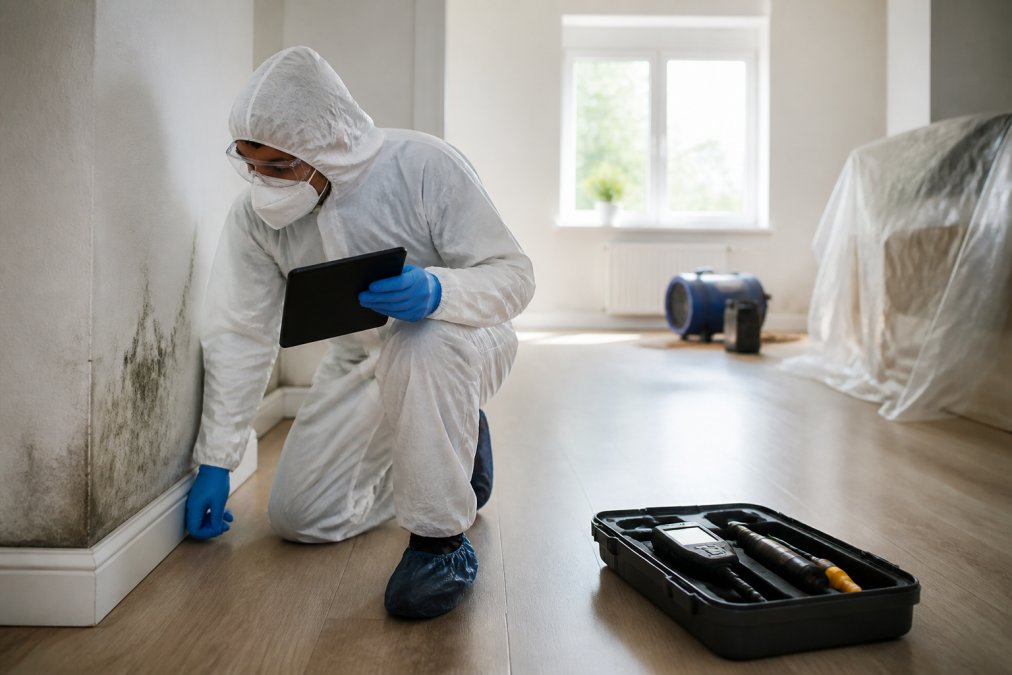
PPE is the last line of defence
Gloves, protective clothing, eye protection and respiratory protective equipment may all be appropriate, but the required combination depends on exposure. HSE’s hierarchy places PPE after measures that eliminate or control the hazard at source. For example, restricting access, preventing aerosols, using suitable tools and placing waste directly into the correct container may reduce exposure more effectively than relying on clothing alone.
Where respiratory protective equipment is required, it must be suitable for the hazard and wearer. Tight-fitting facepieces require an adequate seal and face-fit considerations. A blanket rule that every remediation task requires the same respirator is not a competent substitute for assessment.
What a compliant remediation process looks like
1. Make the area safe
Stop unnecessary access, keep children and animals away, avoid using ordinary vacuum cleaners or pressure equipment on dry contamination, and deal with urgent hazards such as live electrics, unstable flooring or sharps. If emergency services or the police are involved, do not disturb the scene until it has been released.
2. Define the scope
The initial survey should record the contamination source, affected rooms or zones, potentially affected voids and porous materials, access constraints and other hazards. The scope should distinguish cleaning, removal, drying, odour work and reinstatement so that completion of one stage is not misrepresented as completion of all work.
3. Select controls and methods
The method statement should translate the assessment into a safe sequence: isolation, work zones, product use, dwell times, removal of unsalvageable items, equipment decontamination and waste handling. Products should be appropriate for the target organisms and surface. Mixing chemicals or exceeding label concentrations can create additional hazards without improving the result.
4. Remove contamination before relying on disinfectant
Organic material can reduce the performance of disinfectants. Physical cleaning is therefore a critical stage. Materials that cannot be cleaned through their full depth may need controlled removal. For an unattended death, that may include flooring or underlay; for sewage, it may include damaged plasterboard or insulation. Read UKBB’s unattended death cleaning guide for the practical sequence in that context.
5. Prevent cross-contamination
Dirty and clean items should be kept separate. Tools, footwear and waste must not pass through unaffected areas without a controlled route. The contractor should plan how technicians leave the work zone, how reusable equipment is treated and how vehicle interiors remain protected.
Biohazard waste classification, carriage and records
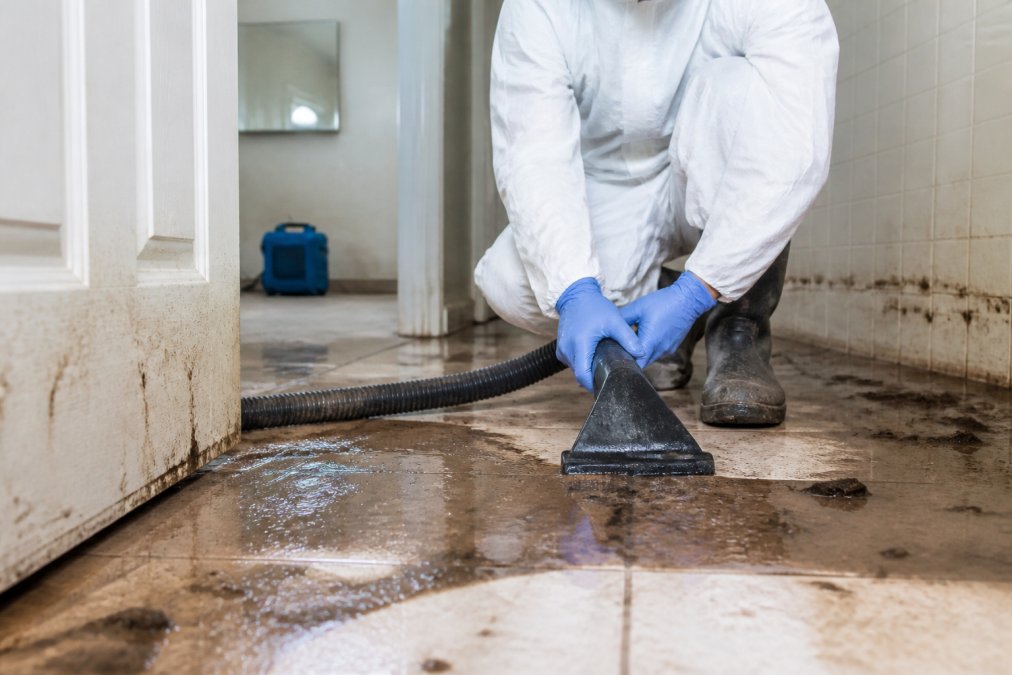
“Biohazard waste” is an informal description, not a complete legal classification. The producer or holder must describe the actual waste, determine the correct List of Waste code, assess any hazardous properties and use the appropriate packaging and documentation. Blood-contaminated waste, sharps, medicines, offensive waste and sewage-damaged furnishings do not automatically belong in the same stream.
Transfer notes and consignment notes
For non-hazardous controlled waste, a waste transfer note or another document containing the required information records the handover. Hazardous waste movements generally require a consignment note. In Scotland, hazardous waste is commonly termed special waste and uses the Scottish special-waste system. Wales retains hazardous-waste producer registration requirements in circumstances set out by Natural Resources Wales, while the premises-registration requirement was removed in England. Northern Ireland has its own hazardous-waste framework and regulator.
That is why a contractor serving several parts of the UK must not reuse one jurisdiction’s paperwork without checking local requirements. The environmental regulators are the Environment Agency in England, Natural Resources Wales, the Scottish Environment Protection Agency and the Northern Ireland Environment Agency.
| Evidence | What to check | Typical retention point |
|---|---|---|
| Waste transfer note | Accurate description, code, quantity, parties, date, place of transfer and carrier details | Business transfer-note records are normally retained for at least two years. |
| Hazardous-waste consignment note | Classification, hazard properties, carrier, destination and completed movement sections | In England, consignment records are generally retained for at least three years; check the relevant national rules. |
| Carrier registration | Name and registration match the person or business collecting the waste | Check the current public register before transfer, not from an undated certificate alone. |
| Destination details | The receiving site is authorised for that waste stream | Retain with the project file and disposal documents. |
Do not accept “general waste” as a description if the load contains separately controlled or hazardous material. A waste carrier registration does not prove that every load, destination or classification is lawful; it is one check within the duty-of-care chain.
Need help with an active contamination incident?
UKBB provides general information. For availability, site assessment or a specialist-cleaning quotation, contact TrustedCare directly.
Verification, records and property handover
Verification should be proportionate to the incident and agreed in advance. There is no single test that proves every biohazard has been removed from every surface. Visual inspection, confirmation that porous contaminated materials were removed, process records, moisture measurements and targeted microbiological testing can each have a role. The method chosen must answer the question posed.
ATP testing, for example, can indicate the presence of biological residue on a sampled surface, but it does not identify a specific pathogen and should not be presented as universal proof that a property is free from infectious risk. Likewise, an odour check may help confirm source removal but is not a microbiological clearance test.
A useful handover pack may include
- The agreed scope and any exclusions
- Risk assessment and method statement
- Before-and-after photographs where appropriate
- Products, concentrations and contact times used
- A record of materials removed or retained
- Moisture readings for relevant water-damage work
- Waste transfer or consignment documentation
- Inspection or test results and their limitations
- Outstanding repairs or reinstatement requirements
- A clear statement of what has been completed
For flood and sewage incidents, decontamination and drying are distinct. A surface can be cleaned while the structure remains wet, and a dry material can remain contaminated. The handover should address both issues where they are within scope. UKBB’s guide to specialist sewage cleaning explains the usual stages.
How to assess a biohazard remediation contractor
There is no single government-issued licence that proves a company is competent for every type of biohazard incident. Vetting should therefore focus on relevant competence, a suitable work plan and traceable evidence.
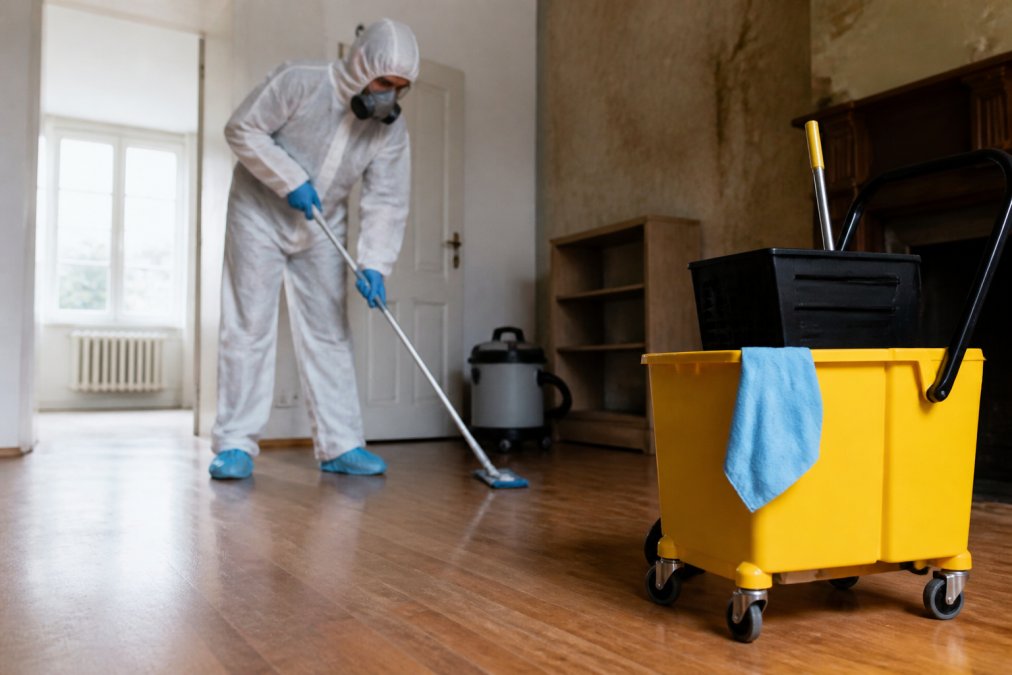
Before instruction, ask the provider to explain:
- who will assess the site and what relevant training or experience they have;
- how the written scope separates cleaning, disposal, drying, odour work and reinstatement;
- which exposure controls and PPE are proposed, and why;
- how disinfectants will be selected and used;
- how clean and contaminated zones will be managed;
- how waste will be classified, packaged, transported and documented;
- what employer’s liability and public liability insurance applies;
- how completion will be verified; and
- what circumstances may change the quote or require additional work.
Price matters, but quotations are only comparable when the scope is comparable. One may include removal of contaminated subfloor, waste charges, documentation and drying; another may cover only surface cleaning. UKBB’s seven-step guide to vetting cleaning companies provides a broader buyer checklist. For a commercial service enquiry, visit TrustedCare’s biohazard cleaning information.
Frequently asked questions
Is biohazard cleaning regulated in the UK?
It is governed through several overlapping legal duties rather than a single biohazard-cleaning Act or licence. Workplace health and safety, COSHH, waste duty of care, hazardous or special-waste rules and other property-specific duties may apply. The exact combination depends on the work, people involved and location.
Does a contractor need a biohazard cleaning certificate?
There is no single government certificate that authorises every biohazard cleaning job. Contractors may hold relevant training certificates, but buyers should also verify practical competence, insurance, risk assessment, waste arrangements and the proposed verification method.
Must every contaminated item be treated as hazardous waste?
No. Classification depends on the waste’s composition, source and hazardous properties. Some contaminated waste may be hazardous or infectious; other material may fall into a different controlled-waste stream. The description, code and handling method must match the actual waste rather than the word “biohazard” alone.
Is a waste carrier registration enough?
No. It confirms an aspect of the carrier’s registration, but the waste must still be described and classified correctly, transferred with appropriate records and taken to a facility authorised to receive it. Registration should be checked on the relevant regulator’s current public register.
Does COSHH apply in a private home?
COSHH governs work activities. It will generally apply when an employer or self-employed contractor carries out remediation in a home. It does not normally regulate ordinary non-work domestic activity by a householder, although other safety and waste duties may still be relevant.
Can ATP testing prove that remediation is complete?
ATP readings can support hygiene monitoring on selected surfaces, but they do not identify particular pathogens and are not a universal clearance test. The verification plan should reflect the contaminant, material, intended use and limitations of the chosen method.
When is a contamination incident reportable under RIDDOR?
RIDDOR covers specified work-related events. Some diagnosed diseases attributed to occupational exposure to a biological agent and certain dangerous releases are reportable by the responsible person. The presence of blood, sewage or another biohazard does not make every incident reportable automatically.
What should I do first after discovering contamination?
Keep people away, avoid disturbing the material, address immediate dangers and obtain a competent assessment. Do not use a domestic vacuum or high-pressure equipment on contamination that could become airborne. If police or emergency services are involved, wait until the scene has been formally released.
Speak to a specialist cleaning team
If you need practical help with biohazard contamination, sewage, an unattended death or another sensitive incident, contact TrustedCare for service information and availability.
Official guidance referenced
- HSE: Control of Substances Hazardous to Health
- HSE: Preventing incidental exposure to infection at work
- HSE: Methods of decontamination
- HSE: PPE against blood-borne viruses
- GOV.UK: Waste duty of care code of practice
- Environment Agency: Hazardous-waste consignment notes
- Natural Resources Wales: Waste duty of care
- SEPA: Waste regulation information
- DAERA: Hazardous waste in Northern Ireland
This article provides general information and is not legal, medical or site-specific health and safety advice. Requirements should be checked for the particular incident and jurisdiction.
