Professional Cleaning After an Unattended Death
What families, landlords and property managers should expect—from scene release and risk assessment to cleaning, waste records, odour control and reinstatement.
The short answer
Professional cleaning after an unattended death is a controlled process for assessing and removing contamination, cleaning and disinfecting suitable surfaces, managing affected materials, reducing odour at its source and documenting the work.
It should begin only after the relevant authority has released the scene and the person instructing the work has lawful authority to provide access. The exact scope depends on the property, time elapsed, materials and contamination pathway—not appearance or smell alone.
This guide provides general practical information. It does not replace advice about a particular death, estate, tenancy, insurance claim or legal responsibility.
What should happen before cleaning begins?
An unattended death may involve the police, coroner in England and Wales, procurator fiscal in Scotland, or coroner in Northern Ireland. Do not disturb the room or remove belongings while the scene remains under official control.
- Wait for formal scene release. Permission to enter must come from the appropriate authority where an investigation is taking place.
- Confirm who can instruct the work. This could be an executor, administrator, property owner, landlord, managing agent or another authorised representative.
- Restrict access. Keep relatives, tenants, neighbours, pets and untrained workers away from the affected area.
- Contact the insurer. Ask whether an inspection, photographs, quotations or approval are required before non-emergency removal or cleaning begins.
- Protect possessions and privacy. Agree how keys, valuables, documents, photographs and sentimental items will be recorded and handled.
- Arrange a competent assessment. The scope should identify affected rooms, materials, hazards, access controls, waste arrangements and likely follow-on repairs.
What professional unattended-death cleaning involves
The service is sometimes described as biohazard remediation, trauma cleaning or after-death cleaning. These are industry terms rather than one nationally licensed activity. The useful question is whether the proposed contractor, controls and method are suitable for the actual risks.
Assessment
Mapping visible and suspected contamination, affected materials, exposure routes, access hazards and areas requiring further investigation.
Controlled cleaning
Removing appropriate contaminated material, cleaning surfaces and applying a suitable disinfectant in accordance with its instructions.
Documentation
Recording the agreed scope, significant removals, waste route, work completed, limitations and follow-on repairs still required.
Professional cleaning is different from a general deep clean. The issue may extend beneath a visible surface into underlay, floor joints, subfloors, furniture, wall junctions or voids. However, this does not mean every item in the room must be discarded. Decisions should reflect the material, condition, contamination and whether it can be cleaned safely.
See our explanations of trauma-scene cleaning and cleaning bodily fluids for related background.
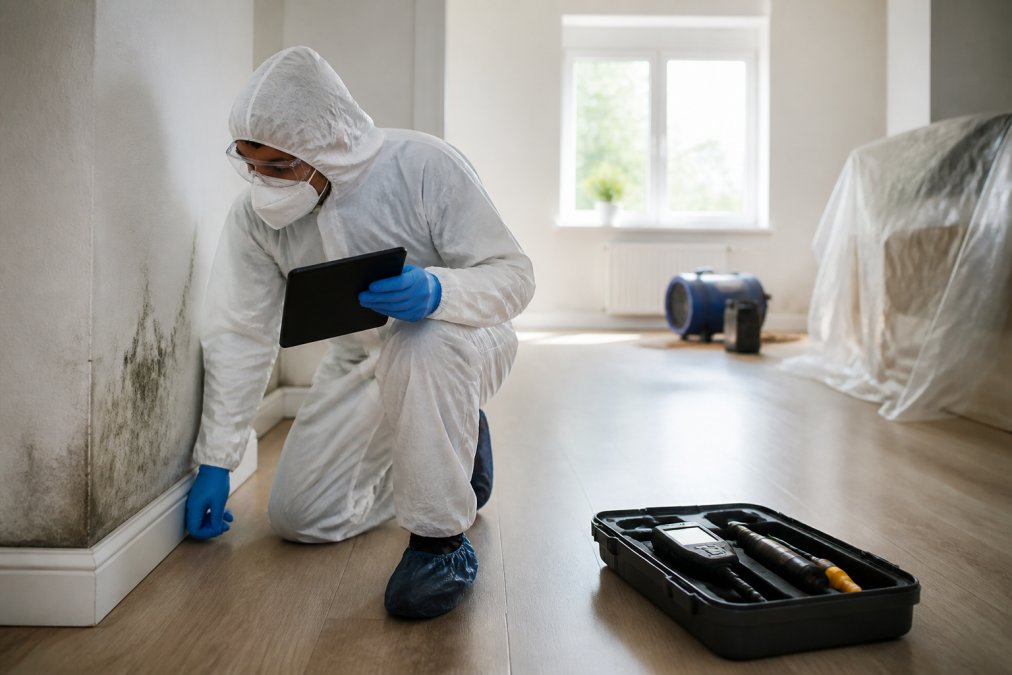
The assessment determines the controls and scope; it should not be replaced by a generic package or fixed checklist.
The professional cleaning process, step by step
1. Assessment and written scope
The contractor records the affected areas, surfaces and suspected migration routes. A risk assessment and method statement should explain exposure controls, PPE, chemicals, removal work, waste arrangements and any limits to the inspection.
2. Proportionate access control
The work area is separated from clean areas using controls suited to the property. This may involve closed doors, barriers, floor protection, dedicated equipment or more extensive containment. Full polythene containment is not automatically necessary in every property.
3. Contents decisions
Items are assessed rather than discarded indiscriminately. Porous materials that have absorbed contamination may be unsuitable for cleaning, while some hard, non-porous or lightly affected items may be recoverable. The client or authorised representative should approve significant removal wherever possible.
4. Removal of contamination and affected materials
Workers use suitable tools and controls to remove material without unnecessarily spreading it. Sharps, broken glass, damaged floors, unsafe utilities and structural weakness may require separate precautions or another competent trade.
5. Cleaning and disinfection
Organic matter is removed before a suitable disinfectant is applied to cleanable surfaces. Product concentration, compatibility, coverage and contact time matter. More chemical is not necessarily better, and incompatible products must not be mixed.
6. Source-based odour treatment
Persistent decomposition odour is addressed by finding and removing or treating the source. Fragrance alone only masks the problem. Secondary air or odour treatments may be considered after source removal, with suitable controls and clear re-entry instructions.
7. Waste segregation and transfer
Waste is segregated, described, packaged, stored and transferred according to its classification and the rules in the relevant UK nation. Not every removed item is automatically hazardous or clinical waste.
8. Completion and handover
The contractor records what was cleaned, disinfected or removed and identifies remaining limitations or repair work. Visual inspection, records and agreed checks may support handover. ATP swabs measure biological residue but are not a universal test proving that every pathogen is absent.
Read our separate guide to decomposition odour and how long it may persist.
Health, safety and practical risks
Risk should be assessed calmly. A deceased person does not automatically create an extreme infectious-disease risk, but blood, body fluids, unknown contamination and damaged surroundings can expose untrained people unnecessarily.
- Contact with blood or other body fluids through broken skin, eyes, mouth or contaminated hands
- Needlestick or cut injuries from sharps, broken glass or damaged building materials
- Cross-contamination through footwear, tools, waste bags and shared routes
- Exposure to cleaning chemicals where products or controls are unsuitable
- Electrical, structural, slip and trip risks within a damaged or neglected property
- Insects or other pests where the property was undiscovered for a prolonged period
- Psychological distress for relatives, neighbours, staff and contractors
For workers, the Control of Substances Hazardous to Health framework may apply to exposure to biological agents and cleaning chemicals. Employers should control exposure using suitable work methods, equipment, hygiene arrangements and PPE rather than relying on PPE alone.
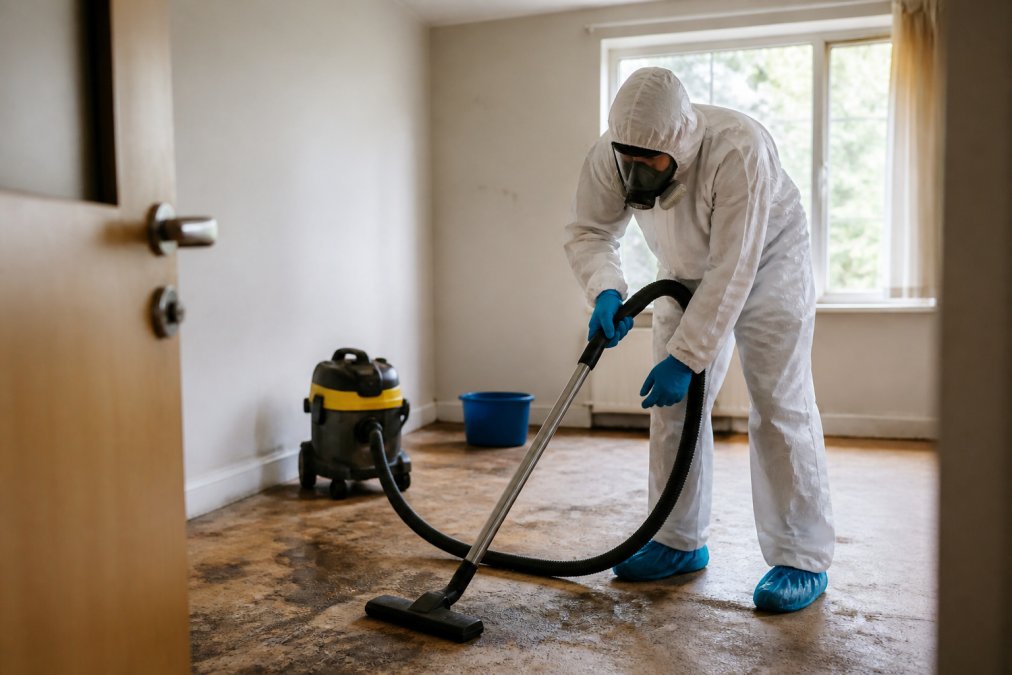
PPE is one part of a wider control system that includes access management, safe methods, hygiene and waste handling.
Waste handling and UK regulatory differences
Waste from an unattended-death clean must be classified before the correct route and paperwork can be decided. Some material may be hazardous or infectious; other material may be non-hazardous. The contractor should be able to explain the classification rather than simply labelling everything “biohazard waste”.
| Question | What a useful answer should cover | Why it matters |
|---|---|---|
| How is the waste classified? | Material, contamination, relevant waste code and hazardous properties where applicable | Classification determines packaging, paperwork and destination |
| Who carries it? | Registration with the regulator for the nation where the business is registered or operating | “Licensed carrier” is often used informally; the check is normally carrier registration and authority |
| What paperwork applies? | Waste transfer note, consignment note or equivalent record, depending on classification and jurisdiction | A hazardous-waste consignment note is not required for every removed item |
| Where does it go? | An appropriately authorised facility able to accept that waste stream | The duty of care continues through the transfer chain |
England, Wales, Scotland and Northern Ireland have separate environmental regulators and some different procedures. A provider working across borders should use the correct registration, documentation and receiving facility for the location and waste movement.
How to choose an unattended-death cleaning provider
There is no single UK licence called “accredited biohazard cleaner”. Training, trade membership and certification can support competence, but no logo replaces a clear assessment, suitable insurance, lawful waste arrangements and an incident-specific method.
| Check | What to ask for | What it does not prove alone |
|---|---|---|
| Relevant experience | Examples of similar property and contamination work | That the proposed scope is correct for this incident |
| Training and supervision | Relevant infection-control, chemical, PPE, sharps and waste training | That every technician has identical competence |
| Insurance | Current public and employers’ liability cover suited to the work | Quality or automatic acceptance by an insurer |
| Waste authority | Current carrier registration and appropriate waste route | That every load is hazardous or needs a consignment note |
| Written scope | Affected areas, methods, removals, exclusions, records and price basis | Hidden damage that could not reasonably be identified initially |
| Property controls | Key management, valuables log, privacy and contents-approval process | A general DBS check is mandatory for every domestic cleaning job |
Ask who will attend, what is included, how variations are approved and where the specialist clean ends. Our seven checks for vetting a cleaning company provide a practical shortlist.
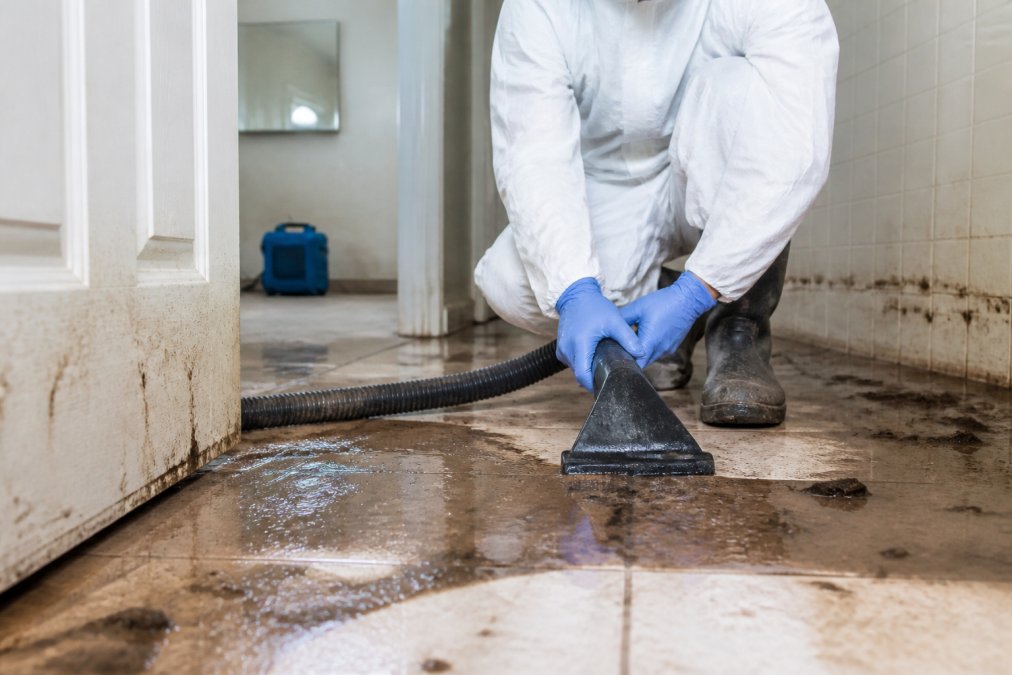
The contractor should explain the method and its limitations in plain language before work begins.
Timescale, reinstatement, cost and insurance
How long does the cleaning take?
There is no dependable standard time. The scope may range from a contained clean to removal across several rooms and voids. Access, time before discovery, temperature, affected materials, property size, contents, waste, odour and hidden migration all affect the duration.
A provider should give an estimate after assessment and state what could change it. Odour treatment, waste collection, drying or repair may continue after the principal cleaning visit.
Cleaning is not the same as reinstatement
The cleaning contractor may remove contaminated carpet, underlay, floor sections, skirting, plasterboard or furnishings where justified. Replacing those items, repairing the substrate and redecorating are separate reinstatement tasks unless the quotation expressly includes them.
Ask for a handover that distinguishes:
- Work completed by the specialist cleaner
- Areas or materials not accessed
- Items removed with approval
- Outstanding drying, building or pest-control work
- Restrictions that remain before repair or occupation
Who pays?
Payment depends on the property, authority to instruct, estate, tenancy, cause, ownership of affected contents and any insurance. A landlord may need to address a property hazard, but that does not automatically decide who bears the final cost. The estate, property owner, landlord, tenant’s insurer, building insurer or another responsible party may be involved.
Read our guides to responsibility for after-death cleaning and insurance for biohazard cleaning. Notify the insurer before significant work where possible and ask what evidence, quotations and approval it requires.
Trauma-informed communication and bereavement
Families and property staff may be making difficult decisions while grieving or in shock. A professional service should minimise unnecessary detail, avoid pressuring anyone to view the scene and provide one clear point of contact.
- Use plain language and explain decisions before acting
- Agree how sentimental possessions will be identified and handled
- Protect the person’s dignity and the family’s privacy
- Avoid unnecessary marking on vehicles, bags or shared entrances
- Provide realistic updates without promising an exact outcome too early
- Signpost bereavement, housing or safeguarding support where appropriate
The cleaning contractor deals with the property. Bereavement support, estate administration, housing decisions and legal advice may require different organisations or professionals.
Frequently asked questions
Can ordinary domestic cleaners handle an unattended-death clean?
A minor, non-contaminated clean is different from blood, body fluids, decomposition or sharps. Where these are present or suspected, use a contractor with suitable risk controls, training, chemicals, PPE, waste arrangements and insurance.
Does everything in the room need to be thrown away?
No. Items should be assessed individually. Some porous materials may be unsuitable for cleaning, while unaffected or cleanable belongings may be retained. Significant disposal should be agreed with the authorised person and insurer where relevant.
Is unattended-death cleaning legally licensed?
There is no single UK unattended-death-cleaning licence. Several legal duties may apply to employers, chemicals, health and safety, waste, transport and insurance. Waste carrier registration is one relevant check, not a complete quality guarantee.
Is all waste from the property hazardous?
No. Waste must be classified. Some contaminated materials may be hazardous or infectious, while other items may follow a different route. The classification determines the correct packaging, paperwork, carrier and destination.
How long does professional cleaning take?
There is no fixed duration. It depends on the affected area, materials, contents, access, time before discovery, waste, odour and whether contamination has reached concealed spaces. A meaningful estimate follows an assessment.
Will insurance pay for unattended-death cleaning?
It may, but cover is not automatic. The cause, policy wording, exclusions, excess, building and contents sections and insurer approval all matter. Notify the insurer promptly and obtain its instructions.
Does a completion certificate prove the property is safe?
No single certificate proves that every risk is absent. A useful handover records the scope, work completed, removals, waste route, limitations and any additional building, utility, drying or pest-control work required.
Get help after an unattended death
For practical advice or a specialist cleaning quote, tell TrustedCare where the property is, whether the scene has been released and who can authorise access.
For an emergency or an active police scene, follow the instructions of the emergency services first.
